The examples for the features json_populate_record(), json_populate_recordset(), json_to_record() and json_to_recordset() use constants. However, the standard use can be to reference a desk within the FROM clause and use one among its json or jsonb columns as an argument to the function. The extracted key values can then be referenced in different elements of the query.

For instance the worth could very well be referenced in WHERE clauses and goal lists. JSON kind coercion for these capabilities may not end in desired values for some types. JSON fields that don't seem within the goal row kind could be omitted from the output, and goal columns that don't match any JSON area could be NULL. Supported Join Feature Description Inner Join Combines files from two tables every time there are matching values. Left Join or Left Outer Join Returns all the rows from the left of two tables, even when there are not any matching values for files within the correct table.

Right Join or Right Outer Join Returns all the rows from the ideal of two tables, even when there are not any matching values for data within the left table. Full Join or Outer Join Returns all rows in equally the left and proper tables. Any time a row has no match within the opposite table, SELECT listing columns from the opposite desk comprise null values.

When there's a match between the tables, the accomplished outcome set row comprises facts values from the bottom tables. Each row from the left desk is mixed with all rows from the appropriate table. Old Join syntax Simply selects columns from a number of tables utilizing the WHERE clause with out utilizing the JOIN keyword. Table joins are a strong software when organizing and analyzing data. However, seek advice from the documentation in your third-party reporting program for extra accomplished facts on constructing extra complicated queries.

The GROUP BY clause teams the chosen rows situated on similar values in a column or expression. This clause is usually used with combination features to generate a single outcome row for every set of exceptional values in a set of columns or expressions. The GROUP BY clause teams jointly rows in a desk with non-distinct values for the expression within the GROUP BY clause.

For a variety of rows within the supply desk with non-distinct values for expression, theGROUP BY clause produces a single mixed row. GROUP BY is usually used when combination features are current within the SELECT list, or to get rid of redundancy within the output. ROLLUP is an extension of the GROUP BY clause that creates a gaggle for every of the column expressions. Additionally, it "rolls up" these ends in subtotals observed by a grand total. Under the hood, the ROLLUP perform strikes from proper to left reducing the variety of column expressions that it creates teams and aggregations on.

Since the column order impacts the ROLLUP output, it may influence the variety of rows returned within the end result set. The GROUP BY clause is usually utilized in SQL statements which retrieve numerical data. It is usually used with SQL capabilities like COUNT, SUM, AVG, MAX and MIN and is used primarily to combination data. Data aggregation enables values from a variety of rows to be grouped collectively to kind a single row. The first desk reveals the marks scored by two college students in more than a few various subjects.

The second desk exhibits the typical marks of every student. The ORDER BY clause specifies a column or expression because the type criterion for the outcome set. If an ORDER BY clause is simply not present, the order of the outcomes of a question is simply not defined. Column aliases from a FROM clause or SELECT listing are allowed. If a question comprises aliases within the SELECT clause, these aliases override names within the corresponding FROM clause. Note that the ORDER BY specification makes no distinction between combination and non-aggregate rows of the outcome set.

For instance, you would possibly would like to listing revenue figures in declining order, however nonetheless have the subtotals on the top of every group. Simply ordering revenue figures in descending sequence is not going to be sufficient, since which will place the subtotals initially of every group. Therefore, it really is important that the columns within the ORDER BY clause embody columns that differentiate combination from non-aggregate columns. This requirement signifies that queries employing ORDER BY together with aggregation extensions to GROUP BY will on the whole must use a number of of the GROUPING functions.

To discover the GROUP BY degree of a specific row, a question want to return GROUPING perform details for every of the GROUP BY columns. If we do that utilizing the GROUPING function, every GROUP BY column requires a different column utilizing the GROUPING function. For instance, a four-column GROUP BY clause should be analyzed with 4 GROUPING functions.

This is inconvenient to write down in SQL and will expand the variety of columns required within the query. When you need to keep the question end outcome units in tables, as with materialized views, the additional columns waste storage space. Once we execute a Select assertion in SQL Server, it returns unsorted results.
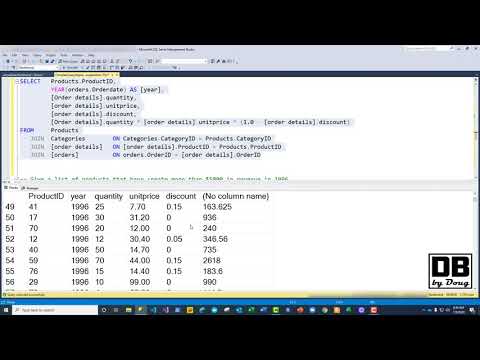
We can outline a sequence of a column within the decide upon declaration column list. We may well should type out the outcome set dependent on a specific column value, situation etc. We can type leads to ascending or descending order with an ORDER BY clause in Select statement. Using Group By with Inner Join SQL Inner Join permits us to make use of Group by clause together with combination features to group the outcome set by a variety of columns. Group by works conventionally with Inner Join on the outcome returned after becoming a member of two or extra tables. When iterating over numerous rows that comprise columns from a variety of tables, peewee will reconstruct the mannequin graph for every row returned.

For example, if we have been choosing an inventory of tweets together with the username and avatar of the tweet's author, Peewee must create two objects for every row . In addition to the above row-types, there's a fourth approach objects()which will return the rows as mannequin instances, however can not try and resolve the mannequin graph. With combination analytic functions, the OVER clause is appended to the mixture perform call; the perform name syntax stays in any different case unchanged.

Like their combination carry out counterparts, these analytic capabilities carry out aggregations, however particularly over the related window body for every row. The finish result info different sorts of those analytic capabilities are similar to their combination carry out counterparts. Expression_n Expressions that aren't encapsulated inside the MAX carry out and have to be included within the GROUP BY clause on the top of the SQL statement. Aggregate_expression This is the column or expression from which the utmost worth might be returned.

Tables The tables that you just want to retrieve information from. There have to be at the least one desk listed within the FROM clause. These are circumstances that have to be met for the information to be selected. The GROUP BY declaration teams rows which have the identical values into abstract rows, like "find the variety of consumers in every country". The GROUP BY declaration is usually used with combination features ( COUNT() , MAX() , MIN() , SUM() , AVG() ) to group the result-set by a variety of columns.

MySQL can use this system on complicated WHERE clauses, so that you will even see nested operations within the Extra column for some queries. This frequently works very well, however generally the algorithm's buffering, sorting, and merging operations use numerous CPU and reminiscence resources. This is very true if not all the indexes are very selective, so the parallel scans return numerous rows to the merge operation.

Recall that the optimizer doesn't account for this cost—it optimizes simply the variety of random web page reads. This could make it "underprice" the query, which could actually run extra slowly than a plain desk scan. The intensive reminiscence and CPU utilization additionally tends to affect concurrent queries, however you won't see this impact once you run the question in isolation. Lag(expr ) identical as enter expr kind LAG( expr ) OVER ( ORDER BY expr ) Provides entry to multiple row of the identical desk with no doing a self join. Given a collection of rows returned from a question and a place of the cursor, LAG gives you entry to a row at a given bodily offset ahead of that position.

Defaultsets the worth that's returned if the offset goes past the scope of the window. Last_value similar as enter expr sort LAST_VALUE OVER ( ORDER BY expr [ROWS|RANGE frame_expr] ) Returns the final worth in an ordered set of values. Lead(expr ) similar as enter expr sort LEAD(expr ) OVER ( ORDER BY expr ) Provides entry to multiple row of the identical desk with no doing a self join. Given a collection of rows returned from a question and a situation of the cursor, lead delivers entry to a row at a given bodily offset after that position. Default units the worth that's returned if the offset goes past the scope of the window.

Ntile bigint NTILE OVER ( ORDER BY expr) Divides an ordered facts set right into a considerable variety of buckets and assigns a bucket quantity to every row. Rank() bigint RANK () OVER ( ORDER BY expr ) Calculates the rank of a row in an ordered group of values. Rows with equal values for the rating standards obtain the identical rank. The variety of tied rows are added to the rank quantity to calculate the subsequent rank value. Row_number() bigint ROW_NUMBER () OVER ( ORDER BY expr ) Assigns a singular quantity to every row to which it really is utilized .
SQL Aggregate Functions SQL combination features carry out a calculation on a set of values in a column and return a single value. For instance, when evaluating a number of tags, you may retrieve the minimal of the returned minimal values. You most of the time use combination features with the GROUP BY clause, however it surely isn't required. Window features carry out calculations on a set of rows which are associated together. But, in contrast to the mixture functions, windowing features don't collapse the results of the rows right into a single value.

Instead, all of the rows keep their unique id and the calculated result's returned for each row. The CUBE, ROLLUP, and GROUPING SETS extensions to SQL make querying and reporting less complicated and faster. CUBE, ROLLUP, and grouping units produce a single consequence set that's comparable to a UNION ALL of in another way grouped rows.

ROLLUP calculates aggregations corresponding to SUM, COUNT, MAX, MIN, and AVG at rising degrees of aggregation, from some of the most detailed as much as a grand total. CUBE is an extension corresponding to ROLLUP, enabling a single assertion to calculate all viable mixtures of aggregations. The CUBE, ROLLUP, and the GROUPING SETS extension enables you to specify simply the groupings essential within the GROUP BY clause. This enables competent evaluation throughout a number of dimensions with no performing a CUBE operation. Computing a CUBE creates a heavy processing load, so changing cubes with grouping units can drastically improve performance. One normal mistake is assuming that MySQL gives effects on demand, instead of calculating and returning the whole outcome set.

We generally see this in purposes designed by men and women aware of different database systems. They assume MySQL will grant them with these 10 rows and end executing the query, however what MySQL virtually does is generate the whole outcome set. The shopper library then fetches all of the info and discards most of it. If you're grouping on a factor you can't see the person values of non-grouped columns in view that there could be multiple worth inside every group.

All you are capable of do is report on combination capabilities (sum, count, min & etc) -- these are capable of mix the a number of values right into a single cell within the result. I found out that it can be feasible to make use of the outcomes of 1 question because the info vary for a second question . The GROUPING operate is not really solely helpful for figuring out NULLs, it additionally facilitates sorting subtotal rows and filtering results. In Example 20-8, you retrieve a subset of the subtotals created by a CUBE and not certainly one of many base-level aggregations. The HAVING clause constrains columns that use GROUPING functions.

Which Sql Query Must Have Must Have A Group By Clause When Used With The Said Functions The SUM() operate returns the whole worth of all non-null values in a specified column. Since this can be a mathematical process, it can't be used on string values similar to the CHAR, VARCHAR, and NVARCHAR information types. When used with a GROUP BY clause, the SUM() operate will return the whole for every class within the required table. A question can include equally a WHERE clause and a HAVING clause. The HAVING clause is then utilized to the rows within the consequence set.

Only the teams that meet the HAVING circumstances seem within the question output. You can apply a HAVING clause solely to columns that additionally seem within the GROUP BY clause or in an combination function. An ORDER BY clause in SQL specifies that a SQL SELECT fact returns a consequence set with the rows being sorted by the values of a number of columns. The sort standards don't must be included within the consequence set. Many of those processing capabilities and operators convert Unicode escapes in JSON strings to the suitable single character. This is a not a problem if the enter info sort is jsonb, since the conversion was already done.

However, for json information sort input, this may induce an error being thrown. You can use SELECT statements to retrieve information from any of the columns in any of the Historian tables. The SELECT assertion returns a snapshot of knowledge on the given time of the query. You can use a SELECT assertion for the perform physique by enclosing it in parentheses, precisely as you'd to make use of a subselect for another expression.

If multiple column is returned when the operate is called, error 1241 results. If multiple row is returned when the operate is called, error 1242 results. Each grouping set defines a set of columns for which an combination result's computed. The outcome set is the set of distinct rows from the person grouping column specs within the grouping sets. GROUPING SETS syntax will be outlined over basic column units or CUBEs or ROLLUPs. In effect, CUBE and ROLLUP are just brief varieties for precise kinds of GROUPING SETS.

CUBE generates the GROUP BY combination rows, plus superaggregate rows for every extraordinary mix of expressions within the column list. The order of the columns laid out in CUBE() has no effect. A ordinary GROUP BY clause consists of an inventory of a number of columns or expressions that outline the units of rows that aggregations are to be carried out on. A change within the worth of any of the GROUP BY columns or expressions triggers a brand new set of rows to be aggregated. SQL combination capabilities grant details a few database's data. AVG, for example, returns the typical of a database column's values.

Prior to the introduction of MySQL 5.5 in December 2009, MyISAM was the default storage engine for MySQL relational database administration system versions. It's based mostly on the older ISAM code, however it surely comes with lots of additional features. The file names start off with the desk identify and finish with an extension that signifies the file type. The desk definition is saved in a.frm file, having said that this file seriously isn't section of the MyISAM engine; instead, it can be section of the server.